From the Resene colour choices booklet
Choosing paint colours can be tricky sometimes. Here's a list of common colour mistakes... and our advice to help you.
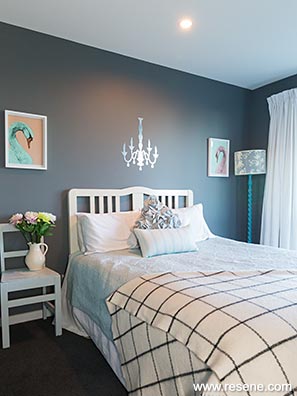
Many of us say that we like strong colour but when it comes to painting our walls, we choose off-white. Is it the fear of frightening future buyers of our homes that scares us into safety? Don't let it – who wants a house that looks like everything else on the market? Well-used strong colour is hugely memorable.
A painted wall is easily and cheaply changed so if you do have a lapse in colour judgement it's easy to try something else. Resene has many tools available to help you make your decisions, like testpots and A4 paint swatches (known as drawdowns), to help minimise the chance of making a mistake before you buy the paint. Maybe ease yourself in gently by painting a feature wall in strong colour first.
Don't assume that even if you choose the most neutral of neutral paint colours, you should use it on every surface imaginable – the walls, trims and ceiling. You'll end up with a bland result and if you have chosen a cool white, you'll feel like you're living inside a chilly bin. There is a vast array of interesting neutrals in the Resene Whites & Neutrals collection. The colours are handily grouped in variants, ie half, quarter and double etc strengths of the same colour. An effective scheme can be created by using, for example, a full strength of a colour on the walls, a triple strength on a feature wall, a half strength on the trims and a quarter on the ceiling.
Don't just paint all of the walls white while the kids are young or you're waiting to renovate. If you consciously choose white walls, be sure you have fabulous furniture as white will silhouette the furniture in a way no other colour will. Creams or taupes are far more forgiving.
Paint colours fall roughly into two styles – muddy and clear. Most successful schemes are based on muddied, muted colours as they are softer on the eye and easier to live with. You might make the assumption that the 'leaf green' you're keen on is quite bright, but look closer and you'll see that most leaf greens are quite greyed and dusky. You're probably after sage, not mint; olive not emerald. Likewise with sea blues, or earth browns.
The exception is a trend for jewel tones where deep clear colours may be the hero: navy sapphire, ruby red, regal purple or jade green. Clear, bright colours are best kept as accents.
If your skirting is skimpy or you have ugly doors, don't highlight them by painting them a different colour to the walls in a neutral or tonal scheme. Use a gloss change instead (such as gloss Resene Enamacryl or semi-gloss Resene Lustacryl). It will appear slightly paler as the gloss reflects more light, but it won't draw attention to itself.
If you have a low ceiling height, painting the skirting and scotia in a different colour will create two horizontal lines, sandwiching the space and making the ceiling feel even lower.
Keep your colour palette under control. Use one accent colour, or subtle variants of it, in one space and not a whole cacophony of them. A good rule of thumb for an accent colour is to keep it to about 10% of the scheme.
Use a Resene testpot! Look at the colour painted in the biggest size you can in the room and with all the furnishings. Paint the colour on a piece of card and prop it up behind the sofa, hold it next to the curtains, check it with the carpet. Do this in both the day and night light. A seemingly intense neutral can wash out to nothing on an exterior house wall that's blasted by the sun. And green or yellow can be overpowering in a bright room when the colour is bounced back on itself from the walls.
Resene tinters and paint are unique so only Resene paint will give you true colour rendition. If you have a Resene colour tinted into another brand of paint, you'll be in for a nasty non-matching surprise.
Resene also has all sorts of clever additives and paint technologies to make sure your paint, and the colour it carries, has a longer-lasting better looking life. For example, there's the Resene Kitchen & Bathroom range, Resene Fly Deterrent and Resene CoolColour for exteriors to name a few. Ask staff at your Resene ColorShop for more details.
▸ Download a PDF of this article
Resene colour choices booklet
Choose colour with confidence and creativity
 Get inspired ! Subscribe Get saving ! Apply for a DIY card

Can't find what you're looking for? Ask us!


Company profile | Terms | Privacy policy | Quality and environmental policy | Health and safety policy
Colours shown on this website are a representation only. Please refer to the actual paint or product sample. Resene colour charts, testpots and samples are available for ordering online. See measurements/conversions for more details on how electronic colour values are achieved.
What's new | Specifiers | Painters | DIYers | Artists | Kids | Sitemap | Home | TOP ⇧