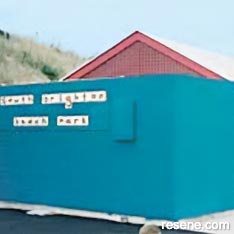
From the Resene paint and decorating problem solver
You’ve probably seen graffiti or tagging somewhere when you're out and about. It’s the words, colours and shapes drawn or painted on buildings, overpasses, trains and fences and other surfaces. It ranges from simple, one colour nicknames (called ‘tags’) to complex arrangements of several colours. It’s done without permission and it’s against the law.
Graffiti is a blight on our environment and extensive resources are needed to combat it in our communities. Graffiti vandalism or tagging is a community problem that can lower property values and encourage more vandalism and other types of crime. It suggests that the neighbourhood doesn’t care and isn’t able to cope with the problem. Tagging left intact merely attracts more tagging. It’s not ok to look the other way. Together there are things that we can do to significantly reduce graffiti. Take action against tagging – record, report, remove.
A strong community response sends a clear message to those involved in tagging that "We will not tolerate it here!" Many people make a real effort to keep their properties free of graffiti. Be proactive and keep your property clean or report tagging immediately to the appropriate organisation for removal.
Internationally, graffiti or tagging is the most common form of vandalism. Overseas studies have shown that the problem of graffiti, if unaddressed, creates an environment where other, more serious crimes such as burglary and assault may take hold.
Record and report
What to do if you see someone tagging:
Ring 111 immediately and report it to the Police. Provide the following information:
The Police are as keen as you are to catch the offenders. Record the
graffiti or 'tag' by taking a photograph, ideally with a digital camera
so
it can be entered into the central tags database. This enables Police
to identify how many tags a tagger has created and the cost of their
removal. This helps when taggers are brought before courts.
If you can do this without alerting the offenders the Police have a better chance of catching them in the act.
The Police will prosecute offenders when caught. The defacement of property by graffiti constitutes an offence of intentional damage under the Summary Offence Act 1981 and can result in imprisonment or a fine.
The typical tagger repeats their scrawl as many times as possible to advertise to other taggers for recognition and status.
If graffiti is removed quickly, the taggers are denied their glory.
Keep some paint handy and simply paint over any tags that do appear. If you do suffer repeated graffiti, be persistent. If need be just paint a patch over the tagged area rather than repainting the whole wall or fence until the graffiti has stopped for an extended period.
Remove graffiti as soon as possible, preferably within 24 hours.
If you are removing graffiti for the first time, try different methods on a small area first to ensure you are not causing more damage. Try, in this order:
The chemicals in graffiti removal products can be hazardous, so always wear protective clothing including a mask. Store out of the reach of children.
Rid an unpainted wall or fence of graffiti by sanding or waterblasting. Waterblasting is very effective on unpainted surfaces. The smoother the surface the more easily it can be cleaned. On unsealed porous surfaces such as brick, concrete and unpolished stone, even complete removal of graffiti on the surface still leaves behind its indelible message. Generally a painted wall is easier to keep graffiti free because any further tags can simply be painted over in the same colour as the original.
Protect the driveway and footpath from paint drips and spills when painting out tagging.
If graffiti has been painted over trees, rub the damaged areas with baking soda and rinse off thoroughly with water.
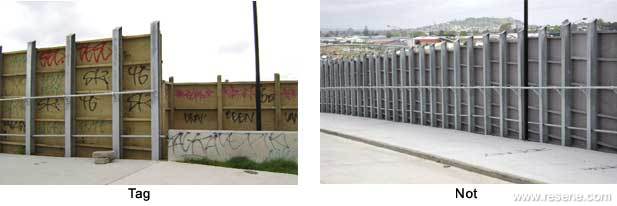
Paint your wall or fence in dark colours - colours that will cover in one coat, such as brown and green, are most effective but may not be suitable for some surfaces.
Chemical removal can be a particularly effective method of removing permanent markers or removing graffiti from steel surfaces.
If you property is continuously being hit there are some steps you can take to help prevent tagging.
Plant shrubs or a tree against walls and fences exposed to tagging or plant climbing shrubs or hedges. Species with prickles provide additional protection.
Paint your fences and walls standard colours because unpainted fences act as magnets to taggers.
If your street front boundary does comprise an unbroken surface that may be appealing to taggers, consider coating it with an anti-graffiti system, such as Resene Uracryl. Once cured you will be able to quickly clean away graffiti with Resene Graffiti Cleaner without damaging the paint finish.
Don’t throw out any unused fence paint: keep it in case you need to use it again. Keep a small pot of your fence paint and a brush handy for quick touchups if needed.
If hiring mini skip bins, request that you receive only graffiti free ones.
Install security nightlights in possible graffiti prone areas. Lights with motion sensors are a popular choice as they only activate when a person approaches.
Install video surveillance cameras. The possibility of being caught on film is a good deterrent.
Do an informal audit of your home or business. Can people jump on your rubbish bin and onto the roof? Is there a dark wall that doesn’t face the street and is poorly lit? Are there bins or bushes that might provide visual shelter for taggers while they graffiti?
Carefully store and dispose of paints. Ensure all spray paint cans you use are completely empty before discarding them and make sure any full or partially full ones are kept well stored.
Organise a paint-out. Gather supplies and community volunteers to remove graffiti in your neighbourhood.
Form or join a Neighbourhood Support Group and develop initiatives to protect areas targeted by taggers. If you live in a graffiti prone area consider having a quantity of communal graffiti covering paint for all to use.
Watch for groups acting suspiciously, particularly at night. Most taggers are aged between 10-21 years old. Ring police immediately if you see someone tagging.
Tagging is wilful damage and therefore a crime. If you see any suspicious activity, report it to the Police. Take a note of the car licence plate if possible.
If you know someone involved in graffiti crime, inform your local Police.
Co-ordinate a graffiti awareness campaign at your local school or in the community.
Consider painting a mural on a communal area being targeted – this often works to deter graffiti and can be a very positive community project. Resene runs a regular Mural Masterpieces competition that assists community groups creating murals – see www.resene.co.nz/murals.htm for details.
The paints, aerosols and marker pens used for graffiti are often acquired by illegal means. The vandal often stores the tools for committing graffiti in their bedroom. Parents should be alert to any unusual number of aerosol spray cans or marker pens in their children’s possession. Retailers should pay attention to any young person repeatedly purchasing items that could be used for graffiti.
Don’t give up! The message must get through that we take pride in our community.
Taggers get away with graffiti because people are reluctant to get involved. It only takes a few minutes to note licence numbers, get descriptions and call the Police but it could save hours of time and thousands of dollars fixing the graffiti that one tagger can cause.
Want to adopt a spot?
Volunteer to:
Volunteers receive resources to help them keep their adopted spot graffiti free.
Resene donates good condition paint and grey waterborne paint collected through the Resene PaintWise service to not-for-profit organisations and schools. This paint is ideal for covering tagging. Find out more and register online or complete a request form at your local Resene ColorShop. In the 18 months to February 2008 Resene has donated over 40,000 litres of paint for graffiti and community work.
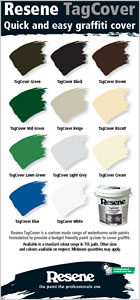
Resene TagCover is a custom made range of waterborne satin paints formulated to provide a budget friendly paint system to cover graffiti. Available in a standard colour range in 10L pails. Other sizes and colours available on request. Minimum quantities may apply.
Resene does not manufacture any spray cans of paint. We do not supply spray cans of paint as part of any sponsorships. As of 1 May 2008, Resene owned ColorShops only sell paint to bonafide trade customers. Spray cans are not available for public sale.
P: 03 941 8999
E:
email info@ccc.govt.nz.
Visit the Christchurch City Council website for more information.
Manukau Beautification Charitable Trust (us)
P: 09 269 4080 or 0800 363 824
E: graffiti@mbct.org.nz
Civic Contractors
P: 09 377 7873
E: graffiti@civcon.co.nz
Recreational Services Ltd
P: 09 443 5011
E: menzit@rs.kiwi.nz
Tag Out Trust
P: 09 826 4276
E: info@tagout.org.nz
To report graffiti to council, call the Whangarei District Council on (09) 430-4200 (24hrs) where a customer service operator will log the incident and your request for graffiti removal (if required). Private and commercial property owners are encouraged to remove graffiti from their property as soon as it occurs to discourage further graffiti from happening.
Report all graffiti vandalism occurring on Northpower transformers to Northpower directly on Freephone 0800NORTHPOWER (0800 667 847) for removal by their certified contractor.
If your council is not listed, report graffiti to your local council.
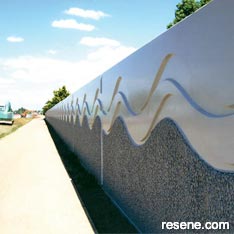
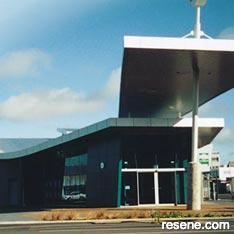
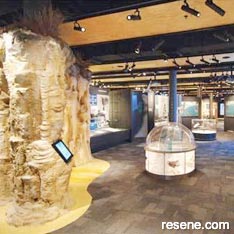
View a selection of projects where Resene anti-graffiti systems have been used:
With graffiti increasing exponentially in many regions, Resene Uracryl 403 Clear is a popular way to protect surfaces so they can be quickly washed down with Resene Graffiti Cleaner when needed.
Resene Paint and Decorating Problem Solver
Learn more about typical painting problems and situations you may find when decorating.
 Get inspired ! Subscribe Get saving ! Apply for a DIY card

Can't find what you're looking for? Ask us!


Company profile | Terms | Privacy policy | Quality and environmental policy | Health and safety policy
Colours shown on this website are a representation only. Please refer to the actual paint or product sample. Resene colour charts, testpots and samples are available for ordering online. See measurements/conversions for more details on how electronic colour values are achieved.
What's new | Specifiers | Painters | DIYers | Artists | Kids | Sitemap | Home | TOP ⇧